
Edge functions and localization
How Edge Functions Transform Global App Experiences

An edge function is a small, serverless piece of code that runs at the “edge” of the network, meaning on servers geographically close to the user, rather than in a centralized data center.
It’s basically a function that executes near the end user, reducing latency and improving speed for dynamic content.
Edge functions are part of the edge computing paradigm, bringing computation and decision-making closer to where data is produced or requested (e.g., user devices, browsers, IoT sensors).
So instead of:
User → Global internet → Data center in Virginia
you get:
User → Edge node in Dublin → Response
Technically
Edge functions:
Run in isolated environments (like V8 isolates or WebAssembly).
Are event-driven (triggered by HTTP requests, cron jobs, etc.).
Cold start almost instantly (milliseconds).
Can read headers, rewrite URLs, or run small logic before reaching the origin server.
Julia, what do Edge Functions have to do with localization, you ask? A lot more than you might think!

Imagine serving personalized content that instantly adapts to a user’s region, language, or even cultural preferences, without ever touching your main server. Edge Functions make this magic possible by running lightweight code right where your users are, allowing global teams to deliver region-aware experiences, tweak translations, or swap imagery and currency formats on the fly.
In short, they turn localization from a static deployment chore into a living, dynamic content generation engine.
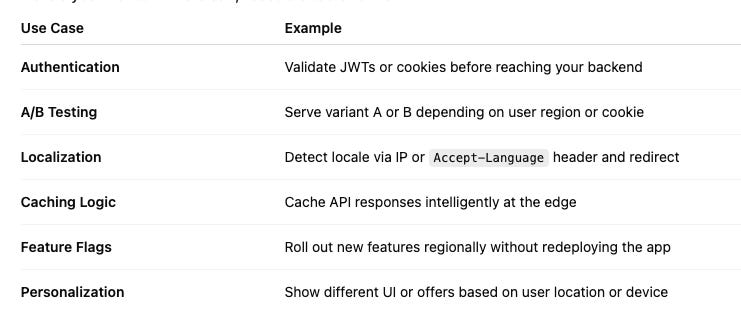
Common Use Cases
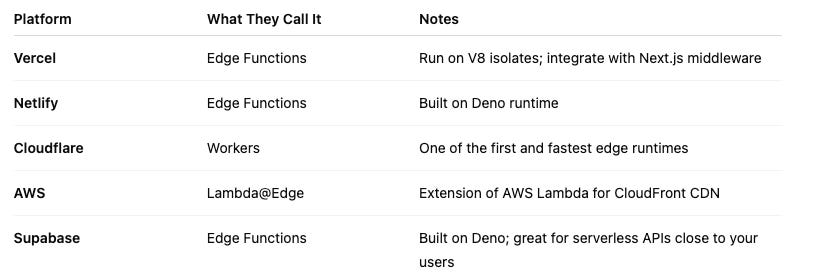
Examples by Provider
Example Code
export default async function handler(req, res) {
  const country = req.headers.get(”x-vercel-ip-country”) || “unknown”;
  return new Response(`Hello from ${country}!`, { status: 200 });
}
This function runs globally and replies instantly with the user’s country, without hitting your origin server.
Edge functions are what happen when marketing meets physics. They let your campaigns move at the speed of geography. For localization specialists, this means the difference between broadcasting and responding. An edge function can detect a user landing on your site from São Paulo and instantly swap your “Back-to-School” banner for “Volta às Aulas,” adjust currency to reais, and trigger a Carnival-themed promo, all before the first image finishes loading. The same campaign might quietly morph in Munich, showing autumn leaves, euros, and a local slogan that actually sounds German. It’s the kind of invisible adaptation that turns global campaigns into living systems where every user feels the message was written, priced, and timed just for them.
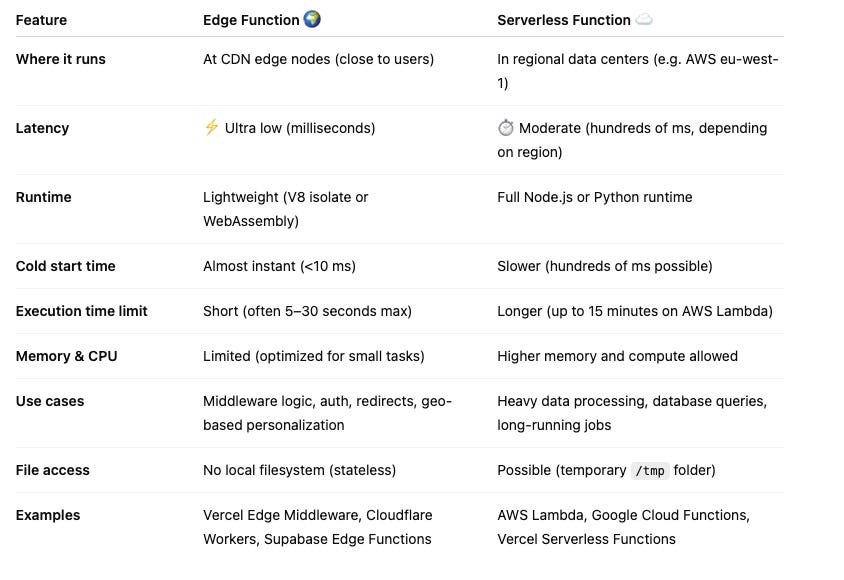
Edge Functions vs Serverless Functions
For localization teams, understanding the difference between Edge Functions and Serverless Functions is key to designing faster, more adaptive global experiences. Both run without traditional servers, but while serverless functions handle the heavy lifting in regional data centers, edge functions live closer to your users, at the very edge of the network. That proximity means instant reactions to language, locale, or market signals, making them ideal for serving culturally tuned content before a page even loads.
Example in Context
Imagine an app flow
🎯 Scenario 1:
Personalized story generation
When a child starts a session, the app detects their locale (e.g., 🇪🇸 Spain, 🇮🇪 Ireland) and adapts vocabulary accordingly.
Edge Function does the locale detection and sets a cookie instantly.
Then → Serverless Function (your story generator) uses that context to generate text via AI.
Result: Super fast UX because the personalization happens before the heavy LLM call.
🎨 Scenario 2:
Content generation (LLM, image, etc.)
Here, you need to:
Call Gemini API for story text
Call Gemini image model for illustrations
Save results to backend
These are heavier and longer tasks, so you’d use a Serverless Function, not an edge one.
🚦 In practice
Edge Functions = “Traffic cops” — they intercept requests, decide routing, apply rules, handle fast logic.
Serverless Functions = “Workers” — they do the actual heavy lifting.
Example Combined Setup (Vercel-style)
app/
├─ middleware.ts → Edge function (redirects, auth)
├─ api/
│ ├─ generate-story → Serverless function (LLM call)
│ └─ generate-quiz → Serverless function
middleware.ts runs globally in <10ms, while /api/generate-story runs in your primary region with full runtime access.
What runs where (practical split)
Edge (fast checks, ~<10ms):
Locale + geo detection, personalization cookie
Route gating
Lightweight auth signal
Feature flags, A/B testing
Cache hints (vary by x-locale, x-plan)
Serverless (heavy work):
Calls to LLM (text + image)
Supabase reads/writes (profiles, progress, purchases)
Stripe customer portal and webhooks
Any long-running or CPU/memory intensive tasks
Caching & Personalization
Static pages: cache at CDN; vary by x-locale header for localized UI.
API responses: generally no cache (dynamic), but you can short-cache read-only endpoints (e.g., GET /api/word-of-the-day?locale=…) for 30–120s to reduce load.
Images: serve via Supabase Storage signed URLs; CDN cache enabled.
Security Checklist
Don’t put provider secrets in Edge code.
Edge can read a JWT but shouldn’t verify it with DB unless you have a short cache or a signed/ public key verification that’s local.
All important checks repeated on serverless (origin of truth).
Use rate limiting: a fast, approximate counter at Edge (e.g., header-based + cookie) and a hard limit in serverless with DB.
You probably don’t get to decide whether your product team uses edge functions — but understanding what they are, and how they work, gives you new influence as a localization Specialist.
It means you can sit in those engineering meetings and say, “Could we trigger locale detection and redirect right at the edge?” or “What if we swapped imagery and taglines based on region before the content even loads?” Edge functions make ideas like these possible. They can pre-select language variants before translation memory kicks in, serve regional campaign assets from the nearest CDN node, or automatically adjust UI currency, date formats, and even tone of voice in milliseconds. Knowing when to ask for an edge implementation turns localization from a backend process into a real-time, on-the-fly experience — and that’s the kind of collaboration engineers love.
It's like your website suddenly gets a lot smarter about where people are visiting from. Instead of making everyone wait for the same generic page to load, it can instantly greet a user in Japan with a Japanese welcome and local prices, making it feel like the site was made just for their neighborhood.