
AI accidentally rediscovers the structure of human thought through language
How large language models reveal the deep cognitive architecture shared across cultures

When scientists trained AI models on massive amounts of text — in hundreds of languages — something surprising happened.
The AI started noticing patterns that no one explicitly told it to look for. It learned that words like dog and perro (Spanish) behave the same way: both often appear near “walk,” “bark,” and “owner.”
So, without any bilingual dictionary, the model quietly built a shared mental map of meaning.
When you visualize that map, dog and perro sit almost on top of each other, in a multidimensional space of ideas.
It’s as if the AI had accidentally rebuilt a universal geometry of human thought.
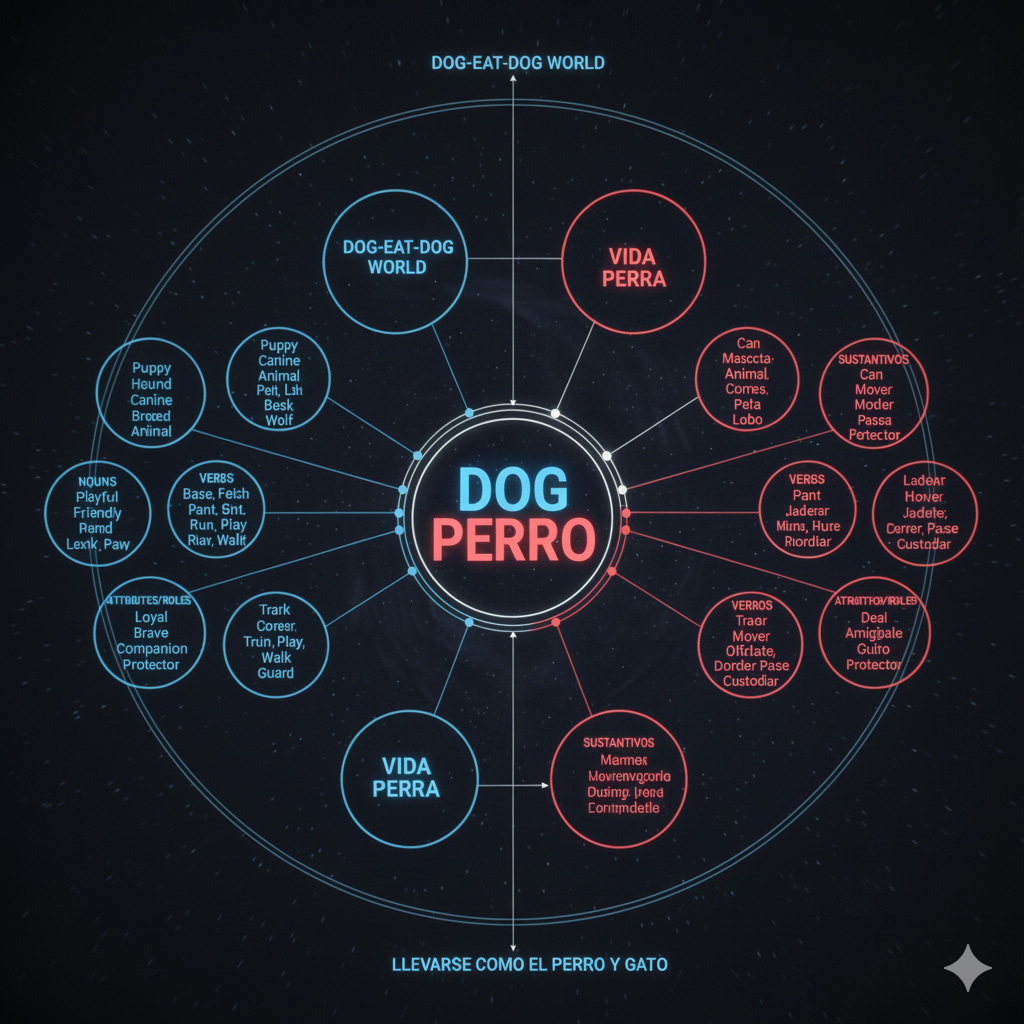
A super AI-generated masterpiece — complete with typos and glorious chaos — illustrating the multidimensional space of ideas between DOG and PERRO. You get the concept.
A universal mental map
Languages look different on the surface — new alphabets, strange sounds, different grammar — but when people talk, they’re usually referring to the same kinds of things: people, objects, actions, emotions, relationships.
AI models discover this because they learn from context.
If you feed them huge text collections and tell them “predict the next word,” they realize that:
“Dog” often appears near “walk,” “bark,” “bone.”
“Perro” appears near “pasear,” “ladrar,” “hueso.”
Even if the words themselves differ, the relationships are identical.
So the AI aligns them naturally, not through translation, but through shared patterns of meaning.
What this tells us about language and thought
This alignment is a form of computational evidence for something linguists and philosophers have suspected for decades:
All languages are built on a shared cognitive architecture, a mental scaffolding we all use to describe the world.
Different tongues, same brain blueprint.
When AI models stumble onto this, they show us something profound:
The structure of human thought is written into the way we use language, and it’s so consistent that even a machine can rediscover it.
But where it breaks — and why that’s beautiful
Of course, not everything aligns so neatly.
Sometimes the AI’s “mental map” gets confused, and those moments tell us just as much about culture as the alignments do.
1. Metaphors don’t always translate
English speakers “spend time,” but in many languages, time isn’t treated like money.
In Spanish, you “pass time” (“pasar el tiempo”).
In Mandarin, you “accompany time” (陪时间).
If the AI learns from context, it’ll see that “spend” in English appears near “money” and “budget,” while the others don’t, and it won’t align them perfectly.
The mismatch reveals a cultural metaphor: how we imagine time shapes how we talk about it.
2. Emotion words carve reality differently
Japanese has “amae”, the feeling of sweet dependency or indulgence in a loved one’s care.
No single English word captures it.
So the AI won’t find a perfect overlap because the concept itself is uniquely carved in Japanese emotional culture.
3. Grammar reshapes attention
Some Aboriginal Australian languages encode cardinal directions in everyday speech (“The cup is north of the plate”).
Speakers develop an almost GPS-like sense of orientation.
The AI can’t align those linguistic habits perfectly with English, where we say “left” and “right.”
Each grammar carries a slightly different mental lens.
When AI learns many languages at once, it rediscovers two truths:
Universality — we share a deep structure of meaning because we inhabit the same physical and emotional world.
Diversity — the way we express that structure varies, carrying each culture’s unique metaphors, priorities, and worldview.
The tension between the two — what aligns and what resists alignment — is where the real insight lies.
Why it matters
For science: AI gives linguists a new microscope to study how language mirrors thought.
For AI ethics: It helps identify where models misinterpret culture — like when metaphors or humor don’t cross boundaries.
For global communication: It shows that translation isn’t just words, it’s mapping between worldviews.
For you and me: It’s a reminder that, underneath our linguistic differences, humans are astonishingly aligned in how we make sense of the world.
AI didn’t mean to uncover a theory of mind.
But by learning to predict the next word, it built a bridge between hundreds of languages, and revealed how much of our thinking is universally human.
And in the rare places where that bridge cracks — where metaphors or meanings refuse to align — we glimpse something even more precious:
the subtle fingerprints of culture on consciousness.
Kinda nuts how companies like Anthropic embody the spirit of 17th century French humanism more than 17th century French humanists
It’s proof that language is a window, not just to the world, but to the collective mind of a culture.
Great read here...