
04 // Multilingual Knowledge Graphs & Market-Aligned AI
From String Processors to Market Owners

I was supposed to write today about automating our agentic pipeline — GitHub Actions, pre/post-tool hooks, the Anthropic SDK. That post is coming.
But today I’m taking a pause. Because before we go further into the automation, I want to stop and recognize one of the most important figures in this whole process.
Can I still call them translators? I’m not quite sure.
A few weeks ago I joined a panel at Traduversia — La traducción en la era de la IA: realidad del mercado y estrategias de futuro — alongside researchers, audiovisual translators, institutional specialists, and localization engineers. Two hours of honest conversation about what AI is actually doing to the translation market. Just people who work in it, talking straight.
One thing that came up early and kept coming back: there is no single translation market. There are many. And they are not all moving at the same speed, or in the same direction.
Not all markets are the same
Regulated institutions — legal, financial, governmental — still rely on traditional translation workflows. Whether a translator uses AI tools, local LLMs, or nothing at all is largely their own call. The accountability structures haven’t changed, so the processes haven’t either.
Tech-oriented localization is a different story. That world is moving fast toward automation. And the more it automates, the more clearly one thing comes into focus: the AI is only as good as the assets you feed it. Garbage in, garbage out — but at scale, and in over thirty languages simultaneously.
This is where the role of the linguist starts to look very different.
From translating strings to curating meaning
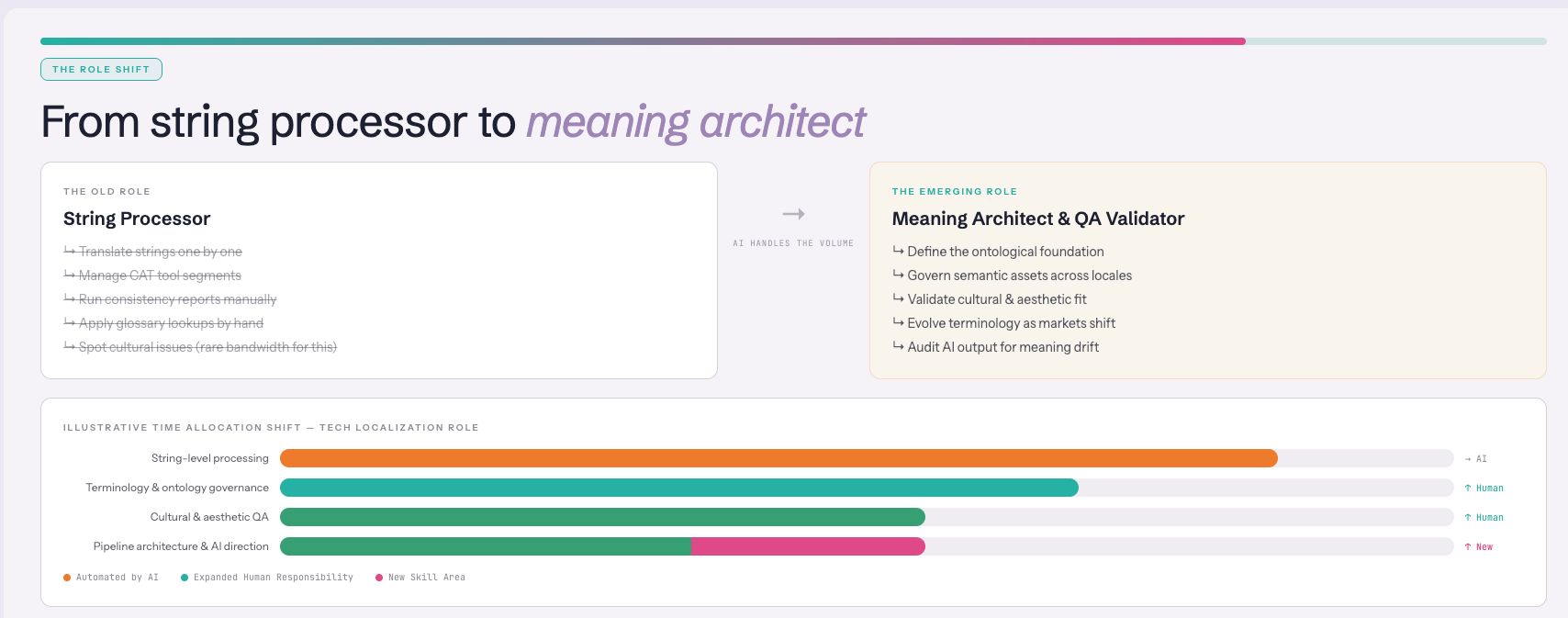
For a long time, the job was to process strings. Source goes in, target comes out. Repeat.
What’s changing — what has to change — is that in automated multilingual pipelines, someone needs to own the foundational assets that keep the LLM on-brand and on-meaning. Terminology. Market definitions. Voice. Cultural context. All the things that determine whether generated text actually works for a real audience in a real market.
That someone is the linguist. But the job looks more like a meaning architect than a string processor. You’re not translating content — you’re building and maintaining the multilingual ontology that guardrails everything downstream.
And then, when there’s a final build to review, you’re not proofreading a document in isolation. You’re walking the real user workflow, in the real product, feeling firsthand how it lands. Does the messaging feel right? Does the UI copy make sense? Are the images and colors working for this market? Anything that feels off — you flag it.
Market Owners and Language Owners
If you follow that logic, you start to realize we might be using the wrong job title entirely.
Not translators. Not localization specialists. Market Owners. Or Language Owners.
A Market Owner brings deep linguistic expertise and native locale awareness — not just fluency, but genuine understanding of how the culture functions, how people make decisions, what feels trustworthy and what feels foreign. They manage terminology with the discipline of someone who knows brand consistency doesn’t happen by accident. They stay ahead of market trends and keep the brand’s cultural profile current. They are, in every sense, the brand’s ambassador in that locale.
A Language Owner doesn't have to be a full-time employee — for most brands entering a new market, there isn't enough guaranteed volume to justify a full-time hire. My preferred model: boutique agencies. A small, dedicated team, hired by the hour. With the right setup, five to ten hours a week is often enough — terminology decisions, QA on final assets, structured feedback. Done well, that's enormous value for brand expansion into a new market.
The key is how you treat them. Respect their expertise. Pay them properly. Give them the context they need to make good decisions. Treat them as the experts they are, and they will become one of your most valuable assets.
Onboarding a Market Owner is harder than it looks
This is probably the most underestimated task in the whole process. A Market Owner can’t make good decisions about your brand until they know your brand. Deeply. Not a quick briefing doc, not a style guide PDF they’ll skim once.
They need to understand your values, your voice, your audience, your positioning — and how all of that translates into their market.
This is where the ontology we’ve been building pays off beyond the pipeline itself.
Feeding the ontology into Google NotebookLM
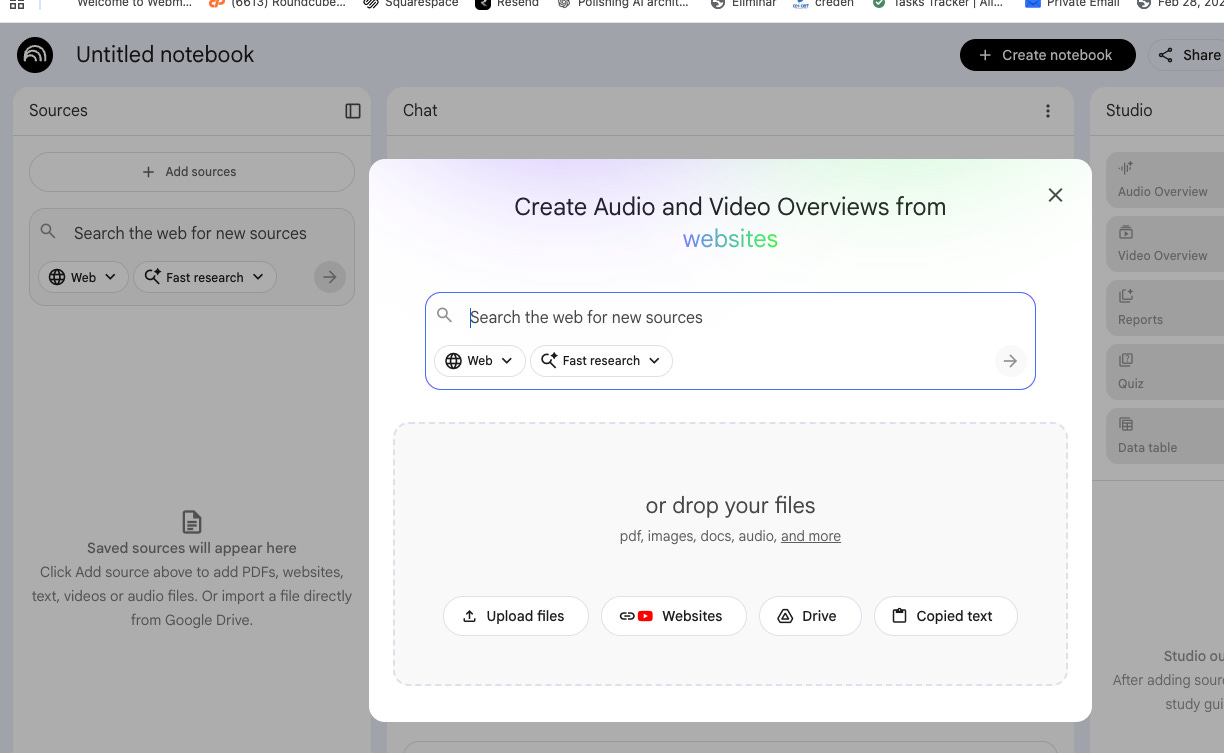
We export our Black Ice ontology and feed it into Google NotebookLM to create onboarding assets for Market Owners. If you haven’t used NotebookLM before, here’s the short version.
NotebookLM is a free Google tool that lets you upload your own documents and ask questions, generate summaries, or create study materials based specifically on your content — not the open web. Think of it as a research assistant that only reads what you give it.
How to get started:
Go to notebooklm.google.com — you need a Google account
Create a new notebook
Upload your sources — PDFs, Google Docs, text files, or paste content directly
Start asking questions, or use the built-in tools to generate summaries, briefings, or FAQ documents
No setup, no API keys, nothing to install. Genuinely accessible for anyone.
Exporting from Black Ice
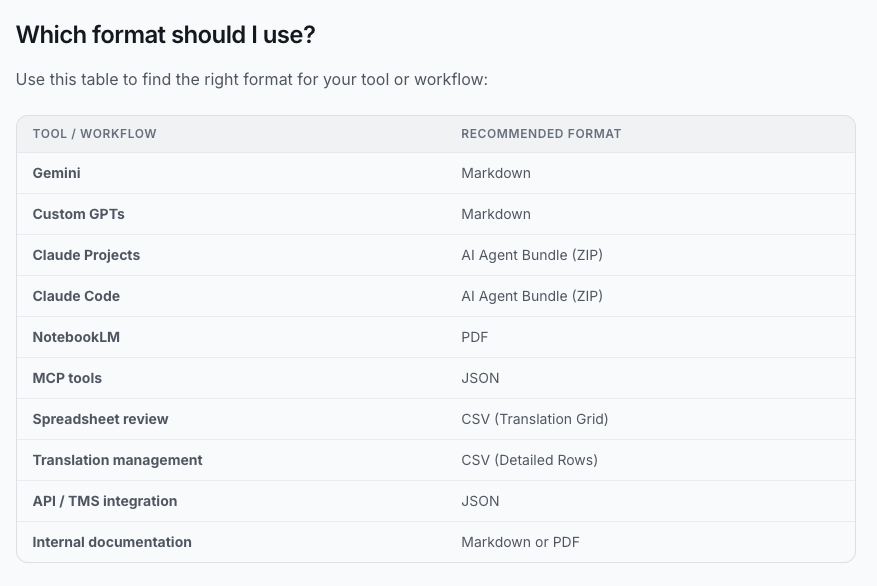
Black Ice exports your ontology in five formats, each built for a different tool or workflow. Knowing which one to use matters.
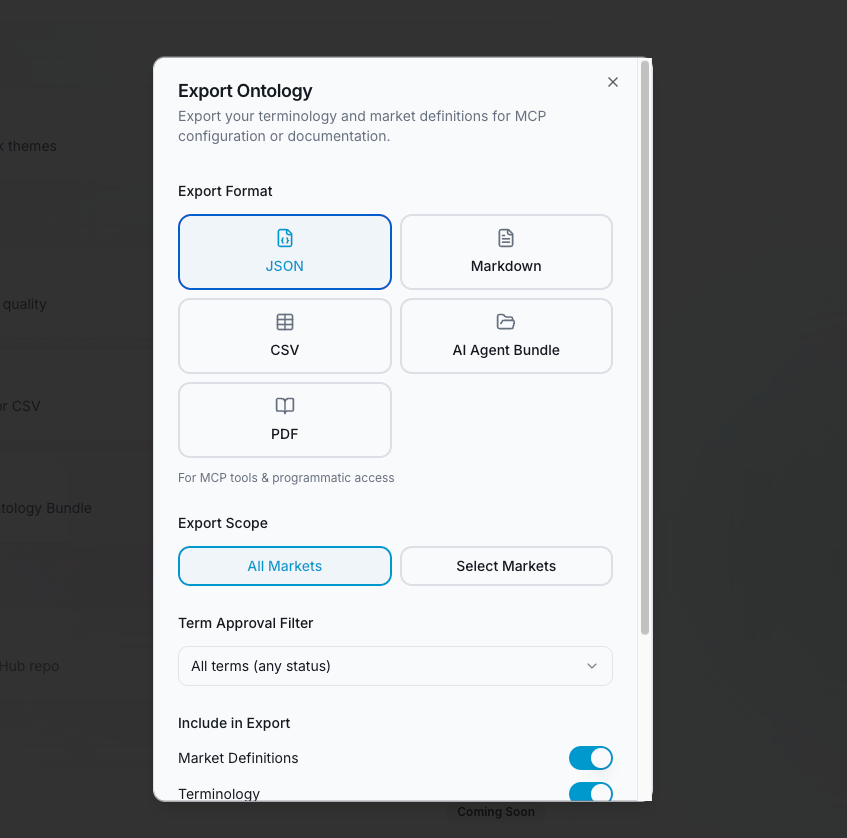
PDF is the newest addition, and the one we’re using here. It produces a fully formatted prose document — concepts organized by class, term tables per locale, market availability summaries, relationship descriptions. The format was built specifically for document-based AI tools.
Which is exactly why it works so well with NotebookLM.
NotebookLM is a document-based AI — it reads sources the way a human researcher would, reasoning across them rather than querying a database. Feed it a PDF and it can generate briefings, answer questions, surface connections, create study guides. Feed it your Black Ice ontology as a PDF, and it becomes a fully oriented brand intelligence tool your Market Owner can interrogate before they make a single decision.
Export as PDF from Black Ice → upload to a NotebookLM notebook → your Market Owner has a living, queryable version of your brand knowledge, in their language, before day one.
Black Ice is the tool we've been using throughout this course to build and govern multilingual ontologies — I've also been contributing to their docs, so if you want to go deeper, start here.
Where the magic happens
Connect the two — a well-structured multilingual ontology and a tool that turns it into human-readable onboarding material — and something shifts.
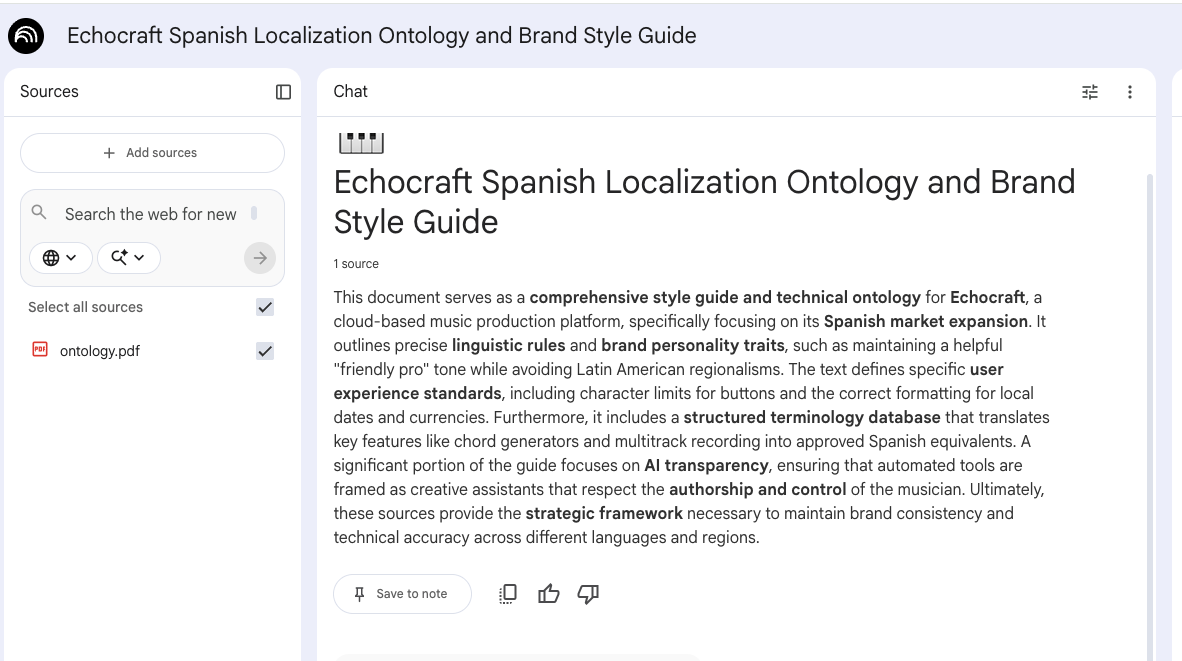
Onboarding stops being a manual process where someone tries to download their institutional knowledge into a new person’s head. It becomes something you can run, iterate, and scale. Your Market Owner arrives already oriented. They spend their first hours making decisions, not searching for context.
That’s the version of the job that makes sense in 2026. Strategic ownership of a market, grounded in real linguistic expertise, supported by the right assets and the right tools.
The linguist didn’t disappear. They just got a better job description.
Here's what I generated for Echocraft Spain's incoming Market Owner. One PDF export from Black Ice. Less than an hour:
